 Business License

What Is Biomass Pretreatment Equipment and Why Is It Important?
Biomass pretreatment equipment is designed to prepare agricultural residues, wood waste, and other biomass materials before they enter power generation, fuel production, pelletizing, biogas, or other downstream processes. Unlike a single biomass shredder, a complete pretreatment system combines feeding, size reduction, conveying, fine crushing, and dust management to create a more stable and usable biomass feedstock.
For biomass power plants and large-scale recycling projects, the challenge is often not simply reducing material size. Straw, corn stalks, bagasse, branches, and other biomass can be bulky, fibrous, irregular, or supplied in both loose and baled forms. A properly designed pretreatment system helps turn these difficult raw materials into a more consistent feedstock for the next processing stage.
ZAECOTECH's biomass pretreatment system is designed for materials including straw, corn stalks, wood waste, bark, and sugarcane bagasse, with reference processing capacities of 15–80 tons per hour depending on configuration.
Why Does Biomass Need Pretreatment Before Energy Utilization?
Raw biomass rarely arrives in a uniform condition. A power plant may receive long straw, bulky stalks, compressed bales, wood residues, or mixed agricultural waste. These materials can create several problems during feeding and downstream processing.
First, biomass can be difficult to feed continuously. Long fibers and bulky materials may bridge or accumulate at the feeding point, while loose biomass can be difficult to control with ordinary feeding equipment.
Second, particle size can vary significantly. A mixture containing long stalks and fine fragments does not provide the same feed characteristics as a controlled-size material.
Third, downstream equipment may require a specific feed size. Biomass used for combustion, pellet production, gasification, or other conversion processes often needs more consistent material characteristics.
Pretreatment therefore serves several purposes:
Reduce oversized and irregular biomass
Improve continuous feeding
Create more consistent particle sizes
Prepare material for secondary crushing or grinding
Reduce manual handling
Improve compatibility with downstream equipment
The goal is not simply to make biomass smaller. It is to create a more stable feedstock for the next process.
What Equipment Is Included in a Biomass Pretreatment System?
A complete biomass pretreatment system normally combines several machines rather than relying on one shredder.
A typical process can be arranged as:
Feeding → Primary Shredding → Conveying → Secondary/Fine Crushing → Dust Collection → Downstream Processing
The main equipment can include:
Metal Chain Plate Conveyor
A heavy-duty feeding system designed to handle bulky, abrasive, or heavy biomass. It provides controlled and continuous feeding into the shredding equipment.
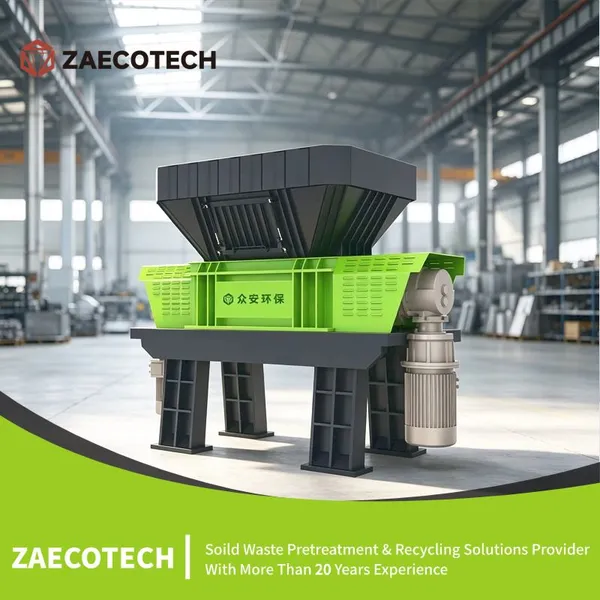
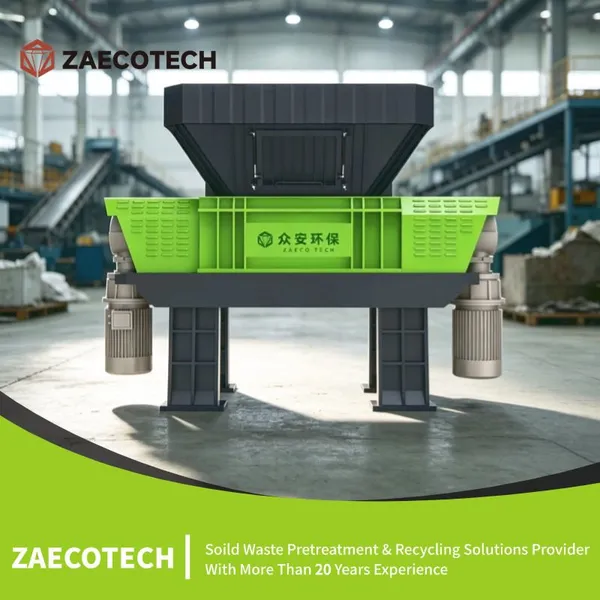
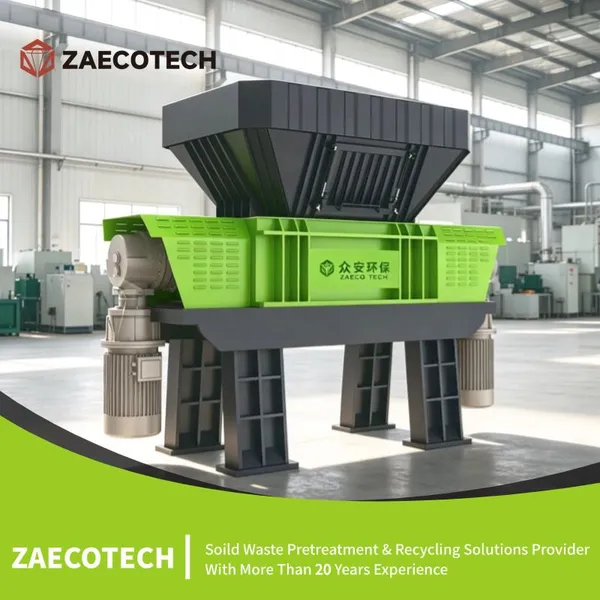
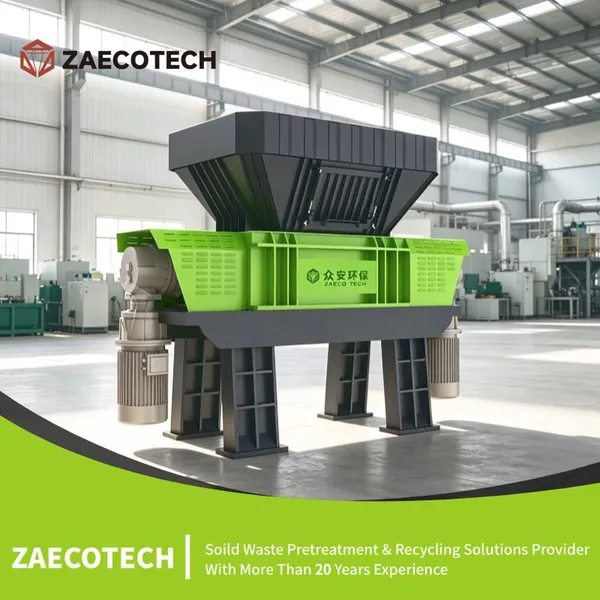
Biomass Shredder
The primary size-reduction machine breaks bulky and irregular biomass into smaller particles. ZAECOTECH uses high-torque shredding technology for materials such as straw, branches, and fruit shells.
Belt Conveyor
Conveyors connect different processing stages and maintain continuous material flow between primary and secondary processing.
Biomass Fine Grinder
For projects requiring finer material, a secondary crushing or grinding stage can further reduce pre-shredded biomass. ZAECOTECH states that its biomass fine grinder can produce a consistent output of ≤5 mm for applications requiring fine particle sizes.
Dust Collection System
Shredding and grinding biomass can generate airborne particles. An integrated dust management system helps capture dust and maintain a cleaner production environment.
This modular structure allows the equipment combination to be adjusted according to the raw material, required capacity, target particle size, and downstream application.
How Does Biomass Pretreatment Equipment Improve Material Handling?
The main advantage of biomass pretreatment is that it creates a more manageable material flow from the beginning of the process.
For example, large or baled biomass can first enter through a heavy-duty chain conveyor. The primary shredder then reduces the material size and breaks apart long or bulky structures. A conveyor transfers the processed material to the next stage, where secondary crushing or fine grinding can provide more precise size control.
This creates a simple processing logic:
Bulky Biomass → Controlled Feeding → Primary Size Reduction → Stable Conveying → Secondary Processing → Prepared Feedstock
The system can also be adapted to different project requirements. ZAECOTECH's current system specifications list 50–150 mm as a reference output range for the pre-shredding stage, while finer processing can be added when the downstream process requires smaller particles.
For buyers, this means the pretreatment system can be designed around the final application, rather than selecting a shredder based only on its nominal capacity.
What Biomass Materials Can the Pretreatment Equipment Process?
Biomass pretreatment equipment can be configured for a wide range of agricultural, forestry, and industrial biomass residues.
Common materials include:
| Biomass Material | Typical Pretreatment Requirement |
|---|---|
| Wheat straw | Primary shredding and size reduction |
| Corn stalks | Shredding and secondary crushing |
| Sugarcane leaves | Controlled feeding and shredding |
| Bagasse | Size reduction and fine processing |
| Wood waste | Heavy-duty shredding |
| Bark | Primary and secondary size reduction |
| Branches | Heavy-duty shredding |
| EFB and other agricultural residues | Customized feeding and shredding |
The appropriate configuration depends on factors such as moisture, bulk density, fiber structure, contamination, feeding condition, and required output size.
For example, loose straw and compressed straw bales may require different feeding arrangements even when the downstream target size is the same. Similarly, wood waste generally requires a different cutting configuration from soft agricultural residues.
This is why biomass pretreatment projects should be designed around the actual material rather than using one standard equipment combination for every application.
What Does a Biomass Pretreatment Project in South Asia Show?
A real biomass power plant project in South Asia demonstrates how a multi-stage pretreatment system can be applied to different agricultural residues.
The project processes wheat straw, corn stalks, sugarcane leaves, and bagasse, with a processing capacity of 20–40 t/h and a target output size of 20–40 mm. The process flow is:
Metal Chain Conveyor → Primary Crusher → Belt Conveyor → Secondary/Fine Crusher → Belt Conveyor
The project is particularly relevant because it does not rely on a single type of biomass. Instead, the system is designed to handle several agricultural residues within the same power-generation application.
According to the project feedback, the equipment has maintained stable operation since commissioning, with throughput of 20–40 t/h and consistent final particle size.
This case demonstrates several practical requirements that biomass power projects commonly face:
High-volume continuous processing
Multiple biomass feedstocks
Controlled output size
Multi-stage size reduction
Stable material transportation between machines
It also shows why a complete pretreatment line can be more appropriate than purchasing a standalone shredder when the project requires continuous industrial operation.
How Should Buyers Choose Biomass Pretreatment Equipment?
Choosing biomass pretreatment equipment should begin with the material and downstream application, rather than the machine model.
Buyers should provide several key parameters:
1. What biomass will be processed?
Specify whether the material is straw, stalks, bagasse, wood waste, bark, EFB, or a mixture.
2. What is the required capacity?
For large industrial projects, capacity may range from several tons per hour to dozens of tons per hour. ZAECOTECH's current biomass pretreatment system has a reference capacity range of 15–80 t/h, while actual capacity depends on material and configuration.
3. What output size is required?
The target size should be determined by the next processing stage. The South Asia power plant project, for example, requires 20–40 mm, while the standard pre-shredding stage can be configured around 50–150 mm and finer processing can be added when necessary.
4. How is the biomass supplied?
Loose biomass, baled straw, bulky wood waste, and mixed residues may require different feeding solutions.
5. What happens after pretreatment?
The downstream application—biomass power generation, pellet production, biogas, gasification, or alternative fuel—directly affects the required output and equipment configuration.
A suitable biomass pretreatment system should therefore be developed around:
Material → Capacity → Feeding Condition → Output Size → Downstream Application → Equipment Configuration
For large biomass energy projects, this approach provides a more practical way to achieve stable feeding, controlled particle size, and continuous operation.
ZAECOTECH provides integrated biomass pretreatment solutions combining shredders, conveyors, secondary crushing or grinding, and dust management according to project requirements. Its South Asia power plant project also demonstrates the application of a 20–40 t/h multi-stage biomass processing system for several agricultural residues.
A well-designed biomass pretreatment system can therefore serve as the connection between difficult raw biomass and a more stable, usable feedstock for downstream energy and resource-recovery applications.
Recently Posted
-
How ZAECOTECH Bulky Waste Shredders Streamline City Cleanups
September 22, 2026In municipal solid waste management and urban sanitation, processing bulky waste—such as discarded sofas, mattresses, wardrobes, c Read More
 -
Solved: The Wind Turbine Blade Recycling Challenge | ZAECOTECH Shredding Solutions
September 20, 2026As the global wind energy sector matures, decommissioned wind turbine blades represent a rapidly growing waste stream. Recycling c Read More
 -
Unlocking Tire Recycling Profits: How ZAECOTECH Tire Shredders Overcome Heavy-Duty Processing Challenges
September 15, 2026In the global scrap tire recycling industry, processing end-of-life tires (ELTs) presents severe mechanical hurdles. From passenge Read More
 -
Maximizing E-Waste Recovery: How ZAECOTECH E-Waste Shredders Solve E-Scrap Processing Challenges
September 14, 2026In the e-waste recycling industry, processing electronic scrap—such as printed circuit boards (PCBs), computer hard drives, consum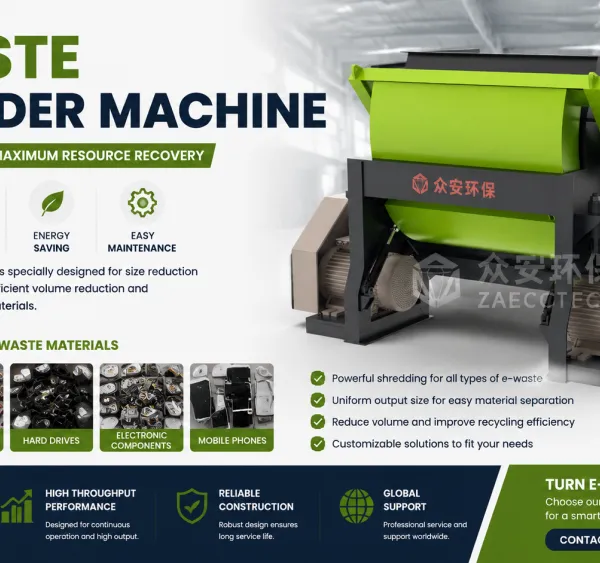 Read More

Contact Us
Recommended Products
-
 Waste Tire Recycling Machine and Process of Recycling Tyres With Rubber Tyre Recycling Plant CostUS$ 15000 - 300000MOQ: 1 Piece
 -
Industrial Recycling Machine Systems and Technology for E Waste and Garbage Recycling in IndiaUS$ 15000 - 300000MOQ: 1 Piece
-
China Recycling Machine for Bulky Waste Shredder and Mattress Recycling MachineryUS$ 15000 - 300000MOQ: 1 Piece
-
Car Tire and Tyre Shredder and Recycling Machine for Tyre Recycling PlantUS$ 15000 - 300000MOQ: 1 Piece
-
Automatic Scrap Tire Shredder and Tdf Production Equipment for Waste Tyre RecyclingUS$ 15000 - 300000MOQ: 1 Piece
-
Car Tire Tyre Recycler and Shredders for Process of Tyre Recycling in ChinaUS$ 15000 - 300000MOQ: 1 Piece
-
Scrap Tire Cutter and Tyre Recycle Machine for Rubber Waste RecyclingUS$ 15000 - 300000MOQ: 1 Piece
-
Shredder for Tyre Powder Business and Scrap Tire Processing Solutions in Italian MarketUS$ 15000 - 300000MOQ: 1 Piece
-
Tyres Tyre Shredder Machine for Sale for Used Tire Recycling CompaniesUS$ 15000 - 300000MOQ: 1 Piece
-
Waste Tyre Recycling Machine and Tire Shredder for Sale in India Scrap Tire Recycling SolutionsUS$ 15000 - 300000MOQ: 1 Piece
-
Industrial Efficient Rubber and Tdf Shredding Crusher Applications for FactoryUS$ 15000 - 300000MOQ: 1 Piece
-
Rubber Tire Tyre Recycling Plant for Sale With Complete System for Waste Tire ProcessingUS$ 15000 - 300000MOQ: 1 Piece
-
Industrial Used Pallet Power Shredder Machine for Sale for Residue Waste ManagementUS$ 15000 - 300000MOQ: 1 Piece
-
Automatic Strong Plastic Crusher Machine Price for Waste Plastic RecyclingUS$ 15000 - 300000MOQ: 1 Piece
-
Cardboard Box Shredder Machine for Industrial Cardboard Shredding and Packaging RecyclingUS$ 15000 - 300000MOQ: 1 Piece
-
High Torque Low Speed Two Shaft Shredder for Efficient Industrial Waste Material Pre-treatmentUS$ 15000 - 300000MOQ: 1 Piece
-
Twin Shaft Rotary Shear Shredder for Specialized Waste Recycling and Contamination Reduction SolutionsUS$ 15000 - 300000MOQ: 1 Piece
-
24/7 Operation High Wear-Resistant Industrial Material Shredder for Waste ManagementUS$ 15000 - 300000MOQ: 1 Piece
-
Tank Shredder Strong Shaft Shredder Machine for Industrial Waste RecyclingUS$ 15000 - 300000MOQ: 1 Piece
-
Two-Shaft Pre-Shredder Manufacturing for Industrial Waste Recycling SolutionsUS$ 15000 - 300000MOQ: 1 Piece